AI Overview for European online stores: What impact on SEO and Google Ads (PPC)?
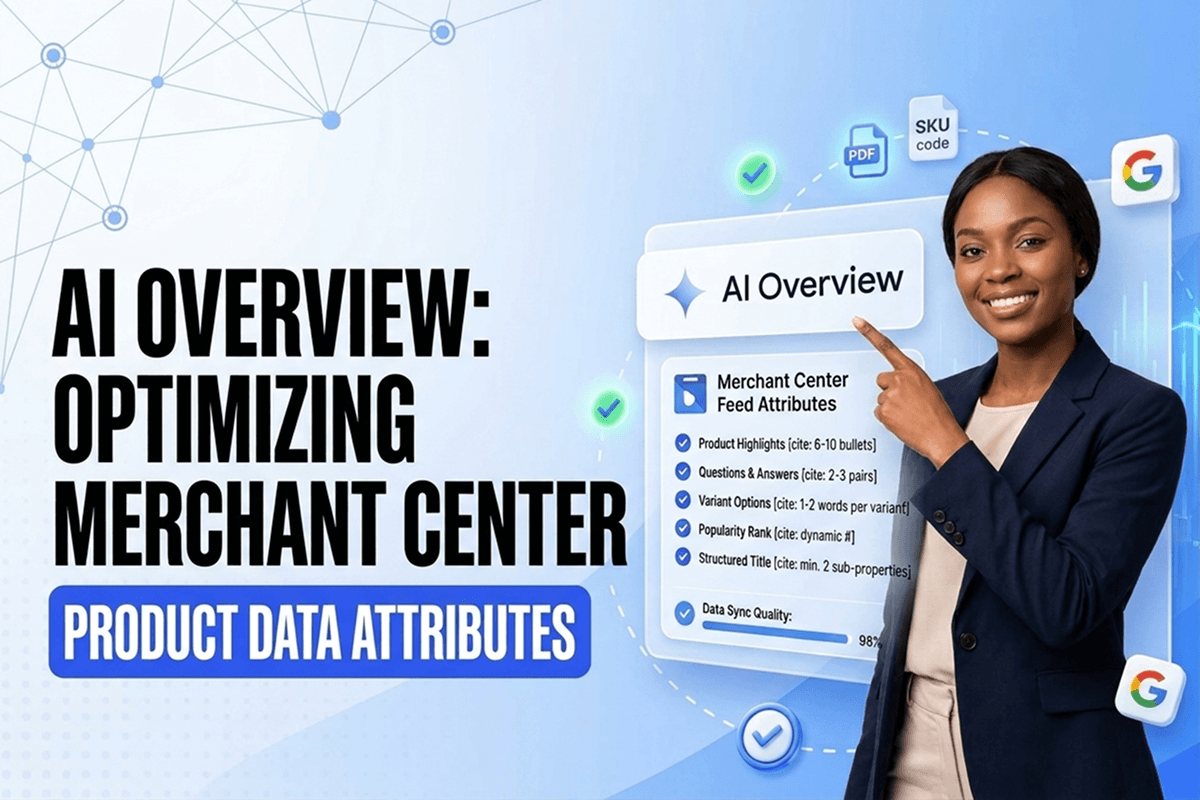
AI Overview is reshaping search behavior. Learn how Google's AI impacts e-commerce SEO and Ads, and discover 14 key Merchant Center attributes to stay ahead.
AI Overview and AI Mode are evolving Google Search towards more direct, richer, and more conversational responses. For an e-commerce brand, the question is not whether SEO is disappearing. The real challenge is understanding where clicks, product discovery, and advertising value are moving.
Informational, comparative, and inspirational searches are the most exposed. Conversely, transactional searches remain more protected. The right response is therefore to reinforce three assets: Google Ads profitability, mid-funnel presence, and product data quality.
Key takeaways
- AI Overview has primarily reduced clicks on informational, comparative, and discovery searches (top of funnel).
- SEO remains useful, but a top position no longer guarantees a citation in AI responses.
- Google Ads profitability and occupying the middle of the funnel are becoming e-commerce priorities.
- An enriched Merchant Center feed helps AI systems better understand the product catalog.
AI Overview and AI Mode: what's the dfifference?
These two features are often confused, even though they do not serve the same use case.
AI Overview is a generated answer in Google results
AI Overview, or AI snapshot, is a response block generated by Gemini that can appear at the top of a results page, before traditional organic links. It synthesizes several sources and answers a question directly.
For certain queries, a person can thus get the essential information without visiting a site. Cited links remain visible, but a citation guarantees neither a click nor a qualified visit.
.png)
AI Mode opens conversational search
AI Mode works as a conversational search space integrated into Google. It allows users to refine a request, ask follow-up questions, and progressively describe a need.
The difference is important for e-merchants. Instead of searching only "running shoes," a person can phrase a request like: "best running shoes to prepare for a beginner marathon".
This evolution favors long, contextual, and need-oriented queries. Brands must therefore be capable of providing precise information on their products, uses, variants, and proof of trust.
Does AI Overview signal the death of e-commerce SEO?
No. SEO remains indispensable to protect a brand's visibility in Google, capture existing demand, and feed search journeys. However, being well-positioned in traditional results is no longer enough to ensure a presence in AI responses.
Data cited in several analyses shows a significant drop in organic click-through rate (CTR) when an AI Overview is displayed. One study notably mentions an approximate 61% drop in organic CTR in this context, while another estimates the CTR drop for the first position at 34.5%.
The problem is simple: the available organic space attracts fewer clicks when Google already provides a complete answer at the top of the page.
The trap for most e-merchants: confusing citation and acquisition
Being cited in an AI overview can boost brand visibility, but it is not the equivalent of a session on your site. Searches enriched by AI Overview frequently generate zero-click journeys, and this logic is even stronger in AI Mode.
It is therefore necessary to move beyond reasoning limited to organic ranking. The metrics to track become broader:
- Your brand's presence in AI answers and comparisons.
- The share of organic traffic on informational queries.
- Branded searches and direct demand.
- Profitability of Search and Shopping campaigns.
- The content's ability to answer complex needs.
The queries most affected by AI Overview
Not all searches have the same level of exposure. This is the most important distinction to make before modifying an acquisition strategy.
The bottom of the funnel remains relatively protected
Highly transactional queries, close to purchase, trigger an AI Overview less often. Mentioned analyses indicate an appearance rate between 3% and 18% for these commercial searches.
A very precise search regarding a specific reference, price, or immediate intent to purchase maintains a logic largely oriented towards product pages, Shopping ads, and merchant results.
The top and middle of the funnel are much more exposed
Comparison, review, selection, and discovery queries are more vulnerable. On these subjects, AI Overviews can appear very frequently, with a cited rate above 95% for comparisons and reviews.
For example, a query such as "how to choose running shoes" can be handled directly by an AI answer enriched with sources, video content, comparisons, and recommendations.
The risk is delayed: if a brand loses visibility during the discovery phase, its bottom of funnel can dry up several months later. Current sales may hold up, while future consideration is already eroding.
Why value is shifting to Google Ads
The decline in organic clicks does not mean demand is disappearing. It mainly changes the distribution of value on the results page.
Initial measurements observed a strong drop in ad CTR when an AI Overview was displayed. But the trajectory then reversed: paid clicks grew on queries with AI Overview, while they declined on queries without AI overviews.
Google has every interest in preserving its ad formats. Advertising remains its main revenue driver, and the simultaneous presence of ads and AI Overviews has grown significantly.
Don't spend more without checking profit margins
The response is not to automatically increase Search or Shopping budgets. The priority is to verify that each additional euro truly supports a profitable product, query, or campaign.
Before accelerating your investments, check two points related to PPC on Google Ads:
- On Shopping: Is your budget concentrated on products that contribute the most to your margin and net result?
- On Search: Are your expenditures directed towards keywords that have the best Quality Scores and useful intent?
Growth remains possible, but it must be managed at the P&L level. A high volume of conversions does not make up for acquisition that destroys profitability.
How to adapt your online brand to AI search?
An adapted strategy combines SEO, content, product data, advertising, and brand building. No single lever is sufficient on its own.
1. Strengthen your visibility on discovery topics
Conversational searches are longer and closer to a conversation with an advisor. Therefore, create content that clearly answers the questions your prospects ask before buying.
Focus particularly on:
- Buyer guides by usage, skill level, budget, or need.
- Honest comparisons between categories or models.
- Answers to frequent objections.
- Content demonstrating product benefits, limitations, and differences.
- Video content optimized for customer searches.
YouTube deserves special attention. The cited analyses show that the platform represents a large share of citations in AI Overviews. Useful content, structured around real customer questions, can therefore support mid-funnel consideration.
2. Diversify trust signals
AI answers are not nourished solely by top-positioned Google pages. The gap between top 10 organic results and cited sources in AI Overviews has narrowed over time.
Visibility depends notably on signals such as:
- Domain authority.
- Freshness of content.
- Presence on review platforms.
- Presence on video and social platforms.
- Consistency of product information across the entire ecosystem.
Reviews, editorial content, videos, and brand proof are no longer peripheral elements. They contribute to making a brand recognizable and credible in less linear search journeys.
3. Prepare mid-funnel ad formats
AI search shifts part of product selection to the middle of the funnel. Campaigns must therefore cover this phase, not just immediate conversion.
Among the levers mentioned are:
- AI Max, to enrich Search campaigns with Google Ads AI capabilities.
- Demand Gen, to create demand through visual and video formats.
- Future formats integrated into AI Overview and AI Mode, such as conversational discovery ads and sponsored highlighted responses.
- Meta and YouTube, to strengthen consideration before the final search.
The goal is to make the brand and its benefits known before prospects arrive at the AI-assisted comparison stage.
Feed optimization: The 14 key attributes to have right now in Merchant Center
To appear there, you must prepare your Merchant Center feed. Here are the 3 steps to make your products visible in AI Overview.
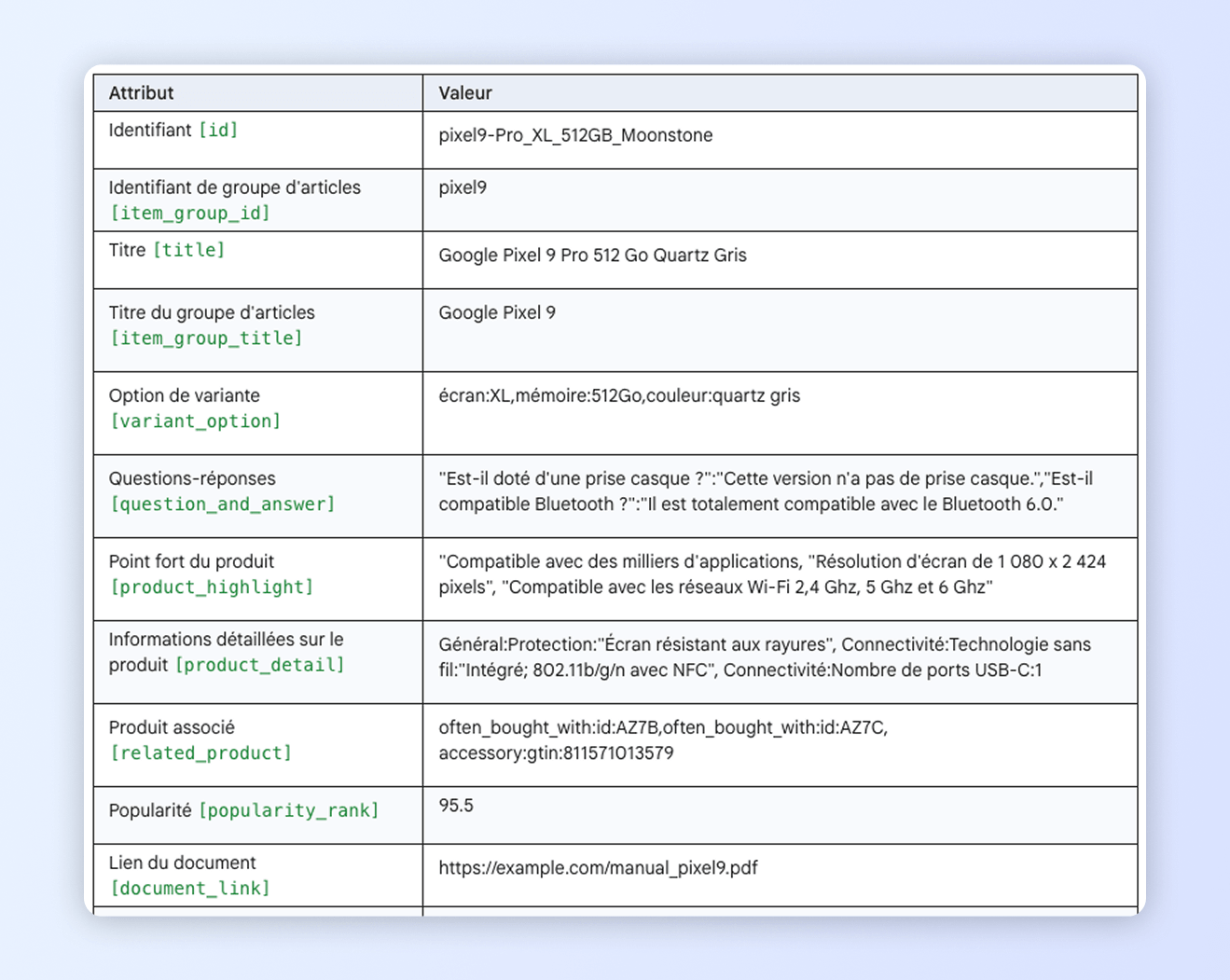
1) On Merchant Center, enrich basic attributes
It seems obvious, but many e-merchants miss this.
In short, make sure to have these attributes optimized in your GMC feed:
[title]– minimum 100 characters[description]– minimum 4,500 characters[google_categories]– must go down to the final leaf nodes[product_type]– minimum 3 nodes (e.g., Cycling > Bike Accessories > Helmets)
2) GEO attributes
These attributes are easy to generate, since they can be created directly from your GMC data.
[product_highlight]– 6 to 10 bullet points (ideal for AI-generated summaries)[product_detail]– 3 to 10 non-standardized technical features per SKU[structured_title]– another version of your titles, with a minimum of 2 sub-properties[structured_description]– another version of your descriptions, with a minimum of 2 sub-attributes
3) Conversational attributes
To gain quality, combine 2 product data sources: GMC + CMS (info present on your product pages).
[question_and_answer]– 2 to 3 real question/answer pairs[document_link]– minimum 1 PDF file per category[item_group_id]– 1 parent code applied to all variants[related_product]– 3 to 5 complementary product IDs[variant_option]– 1 or 2 words per variant (e.g., Material=Leather)[popularity_rank]– a dynamic number from 1 to 100 on each SKU
Why the product feed becomes a strategic asset
A Google Shopping feed (managed directly from GMC) should no longer be considered a simple technical export intended for campaigns. It is a data asset that helps engines, ad platforms, and AI systems interpret your catalog.
The Universal Commerce Protocol, or UCP, illustrates this evolution. This protocol aims to structure product data so that AI agents can better read and leverage it.
The clearer, more complete, and connected to your CMS data your catalog is, the easier it becomes to explain:
- What each SKU sells;
- What need it fulfills;
- Which variants are available;
- Which products are complementary;
- What information can answer questions before purchase.
Before any automation, check data reliability. A long but imprecise description, generic FAQs, or inconsistent product relationships will degrade catalog quality instead of improving it.
Mistakes to avoid facing AI Overview
- Waiting for a drop in revenue to act: The loss of visibility on discovery queries is not always felt immediately. The lag can appear several months later, when brand searches, direct traffic, and bottom-funnel conversions slow down.
- Abandoning SEO in favor of paid: Paid search becomes more strategic, but it does not replace a credible brand, useful content, and reliable product information. Without these assets, ad dependency increases and acquisition costs can become harder to absorb.
- Focusing solely on the Google top 10: Organic ranking retains value, but it does not guarantee an AI citation. You need to develop a broader presence: updated content, reviews, video, relevant platforms, and structured product data.
- Producing content without customer intent: An article or video should not exist solely to target a keyword. It must answer a specific question: which product to choose, for what use, with what criteria, what constraints, and what alternatives.
Action plan: what to do now?
- Enrich your Merchant Center feed: prioritize product, conversational, and relational attributes.
- Map your queries: separate transactional, comparative, informational, and branded searches.
- Measure your exposure: identify queries where AI Overview appears and track CTR trends.
- Protect profitability: analyze the share of the Shopping budget dedicated to truly profitable products.
- Occupy the middle of the funnel: publish content that answers selection and comparison questions.
- Strengthen trust signals: work on reviews, editorial freshness, and brand visibility.
- Test new formats: evaluate AI Max, Demand Gen, and emerging ad opportunities with margin criteria.
What to remember
AI Overview does not end e-commerce SEO. However, it transforms visibility rules, particularly at the top and middle of the funnel. Organic clicks become harder to capture on discovery queries, while Google Ads, consideration content, and product data gain importance.
The best-prepared brands will not be those looking for a single trick to appear in AI. They will be those with a structured catalog, a profitable media strategy, genuinely useful content, and a brand recognized beyond organic results alone.
Frequently asked questions about AI Overview for online stores
Is AI Overview available on all Google searches?
No. Its appearance depends notably on the query type. Comparison, review, and discovery queries are more affected than directly transactional searches.
How do I know if AI Overview affects my SEO traffic?
Track your impressions, positions, and click-through rates in Google Search Console, then compare queries that trigger AI overviews with those that do not. Segment guide, comparison, and review content in particular.
Do all Merchant Center product descriptions need to be modified?
Start with the most strategic categories and products. The goal is to improve accuracy, structure, and data completeness, not to produce long text without useful information.
Do Demand Gen campaigns replace Shopping?
No. Shopping mainly serves to capture demand close to purchase. Demand Gen is involved more in discovery and consideration. These campaigns can be complementary if their role and profitability are measured separately.
Join our monthly tips!
Get fresh insights on Google Shopping optimization delivered straight to your inbox.