6 Reasons to Start Advertising Your Online Store on ChatGPT

Six reasons to try ChatGPT ads for your online store, plus the early results and caveats to weigh before you spend.
Advertising on ChatGPT means paying to show a sponsored product or website below ChatGPT's answer when a user asks a related question. OpenAI began testing these ads on February 9, 2026, and online merchants can now buy them themselves. Here are six reasons to try the channel, followed by the caveats you should weigh before you spend.
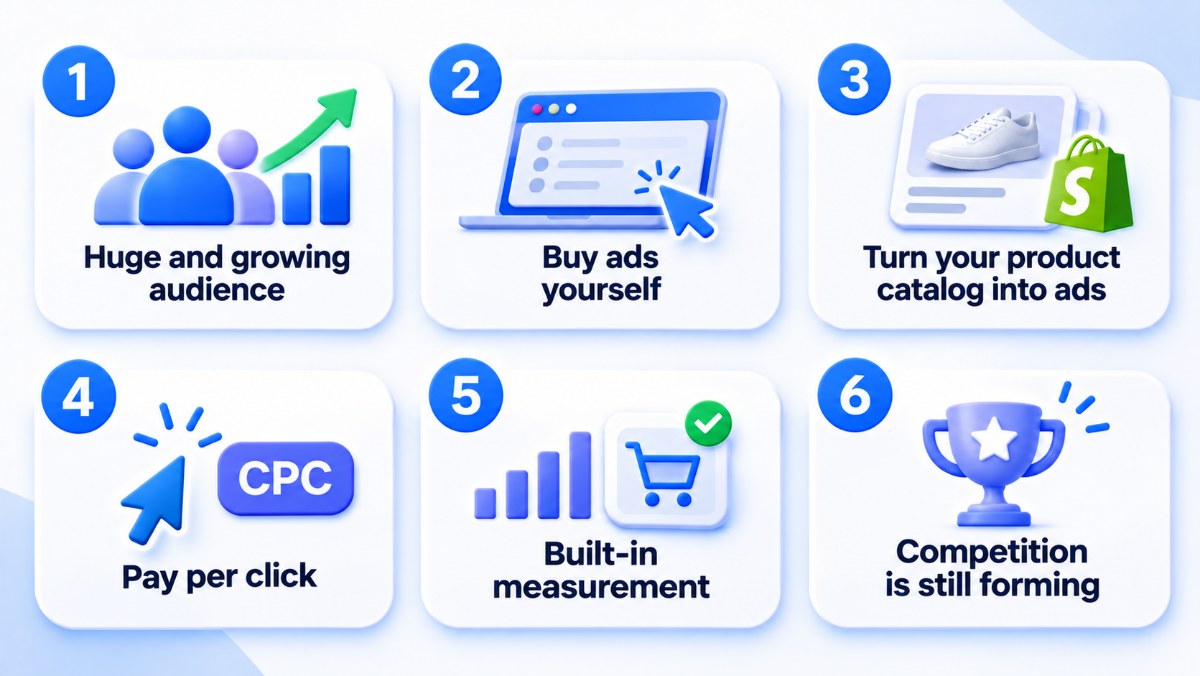
1. The audience is large and still growing
OpenAI says ChatGPT has more than 1 billion weekly active users, and that ChatGPT Ads was available in over 40 countries by August 31, 2026. Ads reach people on the free tiers: the Free and Go plans show ads, while Plus, Pro, Business, Enterprise and Education do not, according to OpenAI. For a retailer, that is a large pool of people who ask for product ideas in a conversation instead of typing a short search.
2. You can buy ads without an agency
At launch, OpenAI worked with a small group of advertisers and agency partners. On May 5, 2026, it introduced a beta self-serve Ads Manager where you add payment details, set budgets, bids and pacing, upload ads and review performance. By August 31, OpenAI said Ads Manager had opened the platform to small and medium-sized businesses. A small team can now try the channel without a large retainer.
3. Your product catalog can become the ad
Catalog-based ads let you connect a product feed, set filters for eligible products, and have ads generated from each product's name, image and attributes, as Digiday reported. If you sell on Shopify, OpenAI's ChatGPT Ads app syncs your catalog and commerce events to Ads Manager, though it is currently available to U.S. customers only, per OpenAI's setup page. A clean, structured product record is the main asset, which is why feed quality matters; see our guide to the key points of an optimized shopping feed.
4. You can pay per click
The first pilot phase used cost per thousand impressions, but OpenAI added cost-per-click bidding so you pay only when someone clicks. OpenAI also says CPC and outcome-optimized bidding account for the majority of campaigns. For a store with tight margins, paying for visits rather than views is easier to plan and cap.
5. Measurement is built in
OpenAI launched a pixel and a Conversions API to track purchases, leads and sign-ups, and advertisers receive aggregated insights instead of individual conversations. That gives you a way to learn which products and messages work. OpenAI also cites an e-commerce advertiser that reported a 3x return on ad spend over 28 days. Treat that as a vendor-reported example, not a benchmark.
6. Competition is still forming
Adthena data cited by Digiday shows the number of distinct brands advertising across the U.S., Australia, the U.K. and the EU growing from 1,082 in June to 6,333 in August 2026. Sensor Tower data in the same article shows shopping's share of U.S. ad spend falling from 38% in April to 20% in September as financial services, software and travel advertisers joined. Retail is not yet crowded, but the field is filling quickly.
| Reason | Evidence | Source |
|---|---|---|
| Large audience | 1 billion+ weekly users; 40+ countries | OpenAI, Aug. 31, 2026 |
| Self-serve buying | Beta Ads Manager from May 5, 2026 | OpenAI |
| Catalog ads | Ads built from product name, image and attributes | Digiday |
| Pay per click | CPC bidding added after the CPM pilot | OpenAI |
| Measurement | Pixel and Conversions API | OpenAI |
| Early window | 1,082 brands in June, 6,333 in August | Adthena via Digiday |
How shoppers find products in a chat
People use ChatGPT to browse ideas, compare options and ask for something specific, like a gift under a set budget. Because the conversation carries more context than a search query, the intent behind a request is richer, and relevant products can appear in two ways. In organic shopping answers, ChatGPT shows product details such as price and availability. Paid placement puts a labeled, sponsored unit below the answer. OpenAI says ads are matched to the topic of the conversation, past chats and past ad interactions, so the shopper does not need to type an exact phrase.
What do shoppers want to see? Clear product information they can trust: an accurate title, a sharp image, the right price and live stock status. Instant Checkout inside the chat is no longer the focus, so your own site completes the sale and has to build confidence quickly. Update product content whenever prices or stock change, include the details a buyer asks about (size, material, use case and category), and write like a helpful salesperson rather than a catalog code. You can also use ChatGPT yourself to test a few shopping questions and see how similar items are described.
What to weigh before you spend
The channel is young, and independent results are mixed. A working paper cited by Digiday found conversion rates of 0.37% for paid ChatGPT visits versus 1.17% for paid Google Search, and revenue per session of $0.89 versus $2.45. OpenAI itself does not publish benchmarks. Also note that on March 24, 2026, OpenAI said merchants can use their own checkout while it focuses on product discovery, so the sale closes on your site and your product pages must convert.
How to try it with a small budget
Plan a short test rather than a full rollout.
- Choose 10 to 20 best-selling products with strong images, accurate prices and clear titles. If titles are thin, enrich your product titles first.
- Set up the pixel before launch so every purchase is tracked.
- Start with a modest daily budget and one optimization event.
- Review results weekly, compare cost per sale with your Google campaigns, and expand only the products that pay back.
To see how AI surfaces compare with classic listings, read AI Mode vs. traditional product listings on Google.
Frequently asked questions
Can I advertise on ChatGPT without a big budget?
Yes. Self-serve Ads Manager lets you set your own budget, bids and pacing, and you can choose cost-per-click bidding.
Will my ad change what ChatGPT recommends?
No. OpenAI states that ads do not influence the answers ChatGPT gives, and they are labeled as sponsored and kept separate from the response.
Do I need a Shopify store?
No. Shopify has a dedicated app, but other stores can send a product feed file through OpenAI's feed process. Our guide to ChatGPT product feed campaigns covers both routes.
Final thoughts
ChatGPT Ads reward stores with accurate, well-written product data, the same foundation that drives Google Shopping results. Improve your data once and let it work on every channel. Clarmix feed enrichment helps you do that across your whole catalog.
Sources
- OpenAI: Testing ads in ChatGPT
- OpenAI: A milestone in expanding access to AI
- OpenAI: New ways to buy ChatGPT ads
- OpenAI: Powering product discovery in ChatGPT
- OpenAI Help Center: Set up ChatGPT Ads for Shopify
- Digiday: OpenAI makes it easier to run shopping ads in ChatGPT
- Digiday: Six thousand brands later, ChatGPT ads still have a conversion problem
Join our monthly tips!
Get fresh insights on Google Shopping optimization delivered straight to your inbox.