The best 9 ProductHero alternatives for Google Shopping management
.jpeg)
Looking for a ProductHero alternative? Compare the 9 best tools for Google Shopping management in 2026, including Clarmix, Shopstory, Channable, DataFeedWatch, Feedonomic
ProductHero is a Google Shopping label management tool that classifies products into performance buckets, and it earned its reputation by making product-level labeling accessible to any PPC specialist. Its Labelizer sorts every SKU in your Google Merchant Center account into four buckets: Hero, Sidekick, Villain, and Zombie. Each label is based on click volume on each product and ROAS, then pushes those custom labels back into Merchant Center so you can build structured Google Shopping campaigns around them. The CSS partnership adds a genuine 20% CPC discount for EU advertisers. At 39 euro/month with a clean interface and fast setup, it's a compelling entry point for any business that wants product-level campaign control without hiring a developer.
ProductHero was built for a specific problem, but the Google Shopping landscape has evolved considerably since. Performance Max (PMax) has replaced Smart Shopping campaigns as Google's default Shopping campaign type , Standard Shopping campaigns remain available, as Google confirmed when it rolled out the self-upgrade tool for Smart Shopping and Local campaigns, and Search Engine Land later reported that Standard Shopping would keep running alongside PMax rather than being phased out. Advertisers are managing larger catalogs with multi-dimensional performance signals. Agencies are running dozens of client setups across multiple countries, and every new Google Ads feature adds another layer to that strategy. And the gap between what a 4-bucket system can tell you and what you actually need to know is widening. PMax adoption itself has kept climbing: survey data cited by Fluency's 2026 Google Ads benchmark report shows advertiser use of PMax rising from 60% in 2024 to 71% in 2025, an 18% year-over-year increase.
If you're hitting those limits , or if you simply need capabilities that ProductHero was never built to provide , this guide breaks down nine alternatives, what they actually do, who they're built for, and what they cost.
What ProductHero does for your Google Shopping strategy (and where it falls short)
Before diving into alternatives, it's worth being precise about what ProductHero offers, because "alternative" means something different depending on your actual bottleneck.
ProductHero's core product is the Labelizer: a two-dimensional classification system that evaluates every product on click volume and ROAS, assigns one of four labels, and writes those labels to Google Merchant Center custom label fields. Campaigns then use listing group filters based on those labels to apply differentiated bid strategies. It also provides PMax Insights (performance breakdown by destination, placement ROAS) and AI-powered product title optimization via GPT.
The limitations are structural. The 4-bucket logic cannot be extended with custom conditions. You can't factor in product price competitiveness, brand, category, availability, margin, or any other feed attribute. A €10 phone case and a €2,000 laptop are classified using the same two rules, even though their conversion dynamics are completely different. If a product is flagged as a Villain (high clicks, low ROAS), the tool won't tell you whether the root cause is pricing, title quality, or simply low demand.
ProductHero starts at EUR 99/month for the Pro plan, with an additional EUR 49 per extra shop or country. For a retailer operating in Germany, Netherlands, Switzerland, Spain, Italy, and the UK, that's EUR 344/month, before any bid management, automation, or spend analytics , a real cost for any business to weigh against a new tool.
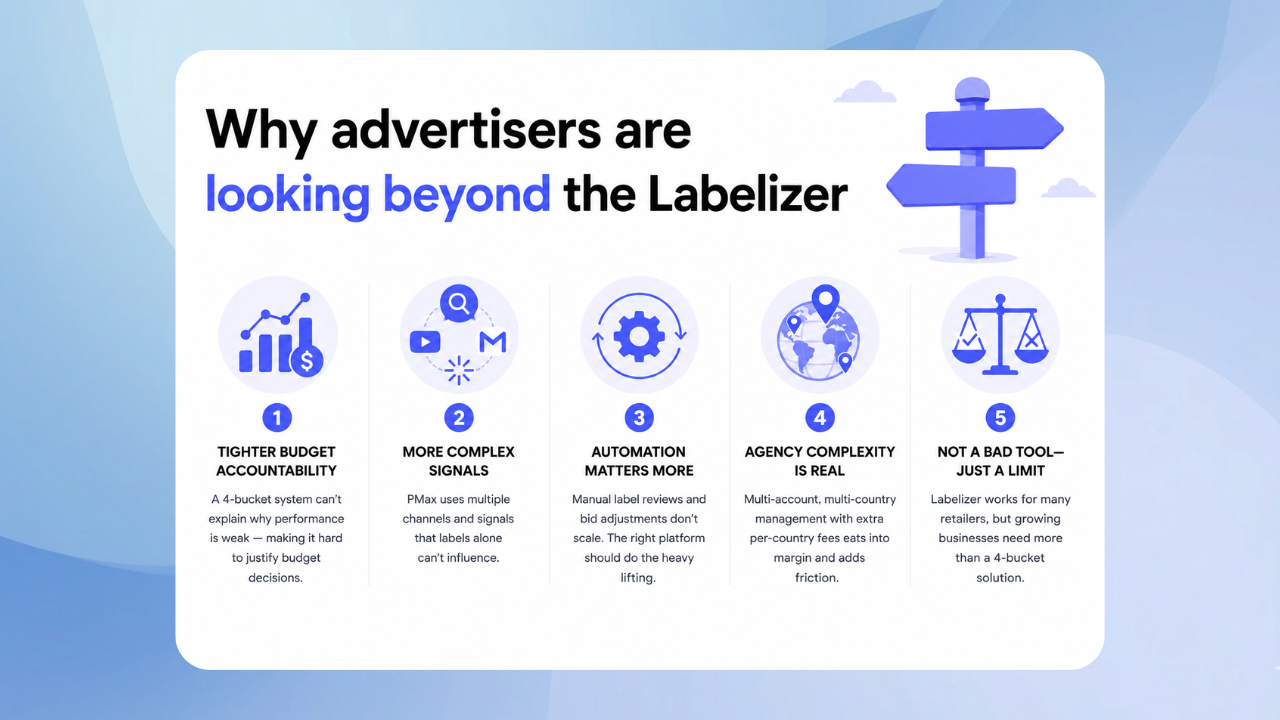
Why advertisers are looking beyond the Labelizer
A 4-bucket labeling system was a genuinely useful shortcut when Google Ads Shopping campaigns were simpler and catalogs were smaller. It's a harder sell today for a few reasons that matter to any business running paid search strategies at scale.
First, spend accountability has tightened over time. Marketing teams are under more pressure to tie ad spend to actual revenue and margin, not just clicks and ROAS. A label that only looks at two dimensions can't tell a finance team whether a "Villain" product is a pricing problem, a demand problem, or a seasonal dip , and that ambiguity makes it hard to defend spend decisions internally.
Second, the keyword and audience layer has gotten more complex over time. PMax pulls in Search, Display, YouTube, Gmail, and Discover inventory into a single Google Ads campaign, and the signals that drive it , audience lists, search themes, creative assets , sit outside what a Merchant Center label can influence. A tool that only writes labels can't help you manage that broader set of levers.
Third, spend pressure has increased the value of automation as a business strategy. Manually reviewing labels, adjusting offers, and reallocating spend across a large catalog doesn't scale well for a lean team, and it eats into the time a PPC specialist could spend on higher-value work.
Fourth, agencies managing multiple clients need a service that handles multi-client, multi-country complexity without per-country pricing eating into margin. ProductHero's EUR 49-per-country add-on is a real constraint here, and it's one of the most common reasons agencies start evaluating new alternatives as part of their broader strategy.
None of this means ProductHero is a bad tool , for a single-market retailer with a moderate catalog, the Labelizer still works well. But if your business has outgrown any of the constraints above, it's worth taking the time to understand what a different tool can offer before you renew.
The 9 best ProductHero alternatives for Google Ads Shopping management
The nine alternatives below cover four distinct categories: feed management, PPC automation, PPC optimization, and cross-network workflow automation. Understanding which category solves your actual problem is the most important step in selecting the right service for your business.
1. Shopstory: cross-network PPC automation for agencies and e-commerce teams
Works with: Google Ads, Meta Ads, Google Merchant Center, Google Search Console
Best for: PPC agencies, multi-market brands
Price: Freemium available; paid plans from €199/month per shop system, unlimited countries
Shopstory is a no-code PPC automation service that extends well beyond Google Shopping. While ProductHero is laser-focused on Google Shopping optimization through a fixed labeling framework, Shopstory automates the full PPC workflow across Google Ads, Meta Ads, Merchant Center, and Search Console , without requiring custom scripts or developer support.
The difference in scope is meaningful. ProductHero provides a single output: product labels in Merchant Center. Shopstory provides programmable multi-step workflows (called "Flows") that can connect data sources, apply logic, push changes across your marketing stack, and trigger alerts. You can do all of that from a visual interface; however, it takes some time to set everything up properly.
Key features:
Pre-built flow library with ready-to-deploy automations including a Labelizer Flow (performance-based custom labels identical to what ProductHero does), ROAS-threshold spend adjustments, keyword pausing, and competitor price reporting
PMax optimization flows that adjust bids and spend based on ROAS thresholds set by the PPC manager, giving back the strategic control that Google Ads Performance Max campaigns typically obscure
ChatGPT-powered title optimization that pulls search term data from Google Search Console and generates new product title suggestions at scale
Cross-network automation covering both Google Ads and Meta Ads, enabling spend and campaign decisions that account for blended performance across each
Custom workflow creation for complex, multi-step automations that go beyond what rule-based systems support , connecting ad performance data to inventory data, pricing signals, and reporting outputs
Scalable pricing architecture: unlike ProductHero's per-country model, Shopstory charges per shop system rather than per country, making international expansion significantly more cost-effective
Reach: genuinely broad. Shopstory is one of the few tools in this space that treats Google Ads and Meta as first-class citizens equally, rather than treating Meta as an afterthought.
Agency or brand? Both, but the workflow automation capabilities and multi-client management make it particularly well-suited to PPC agencies managing campaigns across several clients and markets. Brands that run in-house PPC with a small team also benefit from the automation depth.
Cost and setup time: the freemium tier is enough to test the core Flows, but agencies managing several clients should budget setup time , the visual builder is powerful, but it isn't a five-minute install like ProductHero's labeling module. Teams that already run structured PPC reporting will find the payback period shorter, since Shopstory slots into existing workflows rather than replacing them outright.
Best fit: you're running Google Shopping alongside Meta product ads, you want to automate spend and bid decisions based on ROAS targets, and you need more than four fixed buckets for product segmentation. Shopstory's freemium plan lets you test the core Flows before committing.
2. Clarmix: affordable labelizer alternative with feed enrichment and brand visibility
Works with: Google Shopping, Google Merchant Center, Performance Max
Best for: PPC specialists at agencies and ecommerce brands with over 200 SKUs in their catalog
Price: From €29/month, without engagement period
Clarmix is the most direct ProductHero alternative on this list in terms of core function, and the most affordable. Where ProductHero starts at EUR 99/month and charges EUR 49 per additional country, Clarmix begins at EUR 29/month, including multi-country options, making it a compelling option for any business that wants the product-labeling logic of the Labelizer without paying a significant premium for a brand name.
The labeling framework goes one step further than ProductHero's four fixed buckets.
Clarmix ships with six pre-made labels: Profitable, High Potential, Low Potential, Costly, Zombies, and Zero Conversions. These labels are based on ROAS, clicks, and costs, providing a more nuanced segmentation baseline out of the box.
The more meaningful upgrade is customization: you can change the calculation method behind each label, adjust thresholds, and create entirely new custom labels. ProductHero's 4-bucket logic is fixed; Clarmix treats the labels as a starting point rather than a ceiling.
Key features:
Six default product labels (Profitable, High Potential, Low Potential, Costly, Zombies, Zero Conversions) with configurable conditions , more granularity than ProductHero's Hero/Sidekick/Villain/Zombie framework from day one
Custom label creation allowing PPC specialists to define their own segmentation logic based on ROAS thresholds, conversion rates, spend allocation, or other performance signals , fully outside the constraints of a fixed 4-bucket model
MC feed enrichment module built specifically for Google Shopping feed optimisation, supporting attributes such as titles, categories, product highlights, and product details , aligned with Universal Commerce Protocol best practices for entity optimisation readiness. Once products are enriched, you can synchronize them to Merchant Center in one click through a supplemental feed.
Intelligent PMax dashboard with campaign-level and product-level performance tracking, including ROAS visibility and spend pacing , giving PPC specialists the visibility into Performance Max that Google's native interface doesn't provide
No CSS bundling: Clarmix does not offer a CSS discount, which means you retain full flexibility to use your preferred CSS partner independently; if you already work with a CSS provider, this is an advantage rather than a gap
Collaborative workspace model supporting both agency access and in-house brand teams , a PPC specialist from an agency and a traffic manager from the ecommerce business can work inside the same Clarmix workspace simultaneously without separate logins or access tiers
Reach: focused. Clarmix is built for Google Shopping, Merchant Center, and Performance Max , the exact stack ProductHero targets. It does not extend to Meta Ads, Amazon, or broader feed distribution across other destinations.
Agency or brand? Both, by design. The collaborative workspace architecture means agencies and their ecommerce clients can work inside the same instance, which removes the friction of handoffs and view-only access that can slow down label reviews and campaign adjustments.
Best fit: you want the core functionality of ProductHero's Labelizer , product-level labels pushed to Merchant Center, used to drive segmented bid strategies in Google Shopping and PMax , but the fixed 4-bucket logic isn't granular enough for your catalog, and EUR 99+/month doesn't fit your spend or your client billing model. At EUR 29/month, Clarmix delivers more labeling flexibility, a built-in feed enrichment tool, and a PMax dashboard in a single, competitively priced package. It's particularly well-suited to agencies managing multiple smaller clients where per-tool pricing compounds quickly.
.png)
3. Smarter Ecommerce (smec): PPC optimization and return on ad spend for mid-to-large retailers
Works with: Google Ads (Shopping + PMax), Microsoft Ads, Amazon Ads
Best for: Mid-to-large ecommerce retailers, tech-driven agencies
Price: Custom enterprise pricing; positioned for accounts with significant ad spend
Smarter Ecommerce (smec) operates in a different category than most tools on this list. Where feed management tools clean up your product data and automation tools handle repetitive bid adjustments, smec focuses on PPC optimization, specifically on steering AI-driven systems like Google's Performance Max using real business data.
The core premise: the PMax algorithm optimizes for efficiency metrics like ROAS, but ROAS is not the same as profit. A product with a 10x ROAS and a 5% margin may be less valuable to the business than a product with a 4x ROAS and a 40% margin. smec integrates margin data, stock levels, and cross-network performance signals directly into campaign decision-making, enabling advertisers to prioritize actual profit over surface-level efficiency.
Key features:
Profitability-based campaign steering: pushes high-margin, high-demand, and strategically important products into PMax and Google Shopping campaigns based on business data, not just click-and-ROAS signals
PMax feed segmentation: multi-dimensional product grouping that gives advertisers control over which products PMax promotes, rather than letting the algorithm decide without guardrails
Business intelligence integration: connects margin data, stock levels, and pricing information into the bidding and spend optimization layer , something most PPC automation tools cannot do
Cross-network view: unified reporting across Google Ads, Microsoft, and Amazon Ads, enabling spend allocation decisions that reflect the full picture rather than per-source ROAS silos
Managed service model: smec operates as a tech-driven agency, combining its software with specialist client management, which distinguishes it from pure self-serve SaaS tools
MER and profitability tracking: reporting built around Marketing Efficiency Ratio (MER) and contribution margin, not just ROAS and COS
Reach: Google-primary but meaningfully broad, with strong Microsoft Ads and Amazon Ads capabilities for retailers who run across search and marketplace environments.
Agency or brand? Primarily direct relationships with mid-to-large ecommerce brands. smec positions itself as a strategic partner rather than a software subscription, which makes it more suited to retailers with substantial catalog sizes and ad spend than to small advertisers or agencies reselling access. Its own 2025 review of PMax adoption trends notes that Google's Performance Max spend share peaked at just under 82% in May 2024 before easing back roughly 6 percentage points by early 2025, as advertisers began reintroducing Standard Shopping alongside it for more control.
Best fit: you manage a large catalog , more than 5,000 SKUs, for example , you've noticed that PMax is spending budget on low-margin products while neglecting your strategic lines, and you want a partner who will integrate real business data, not just historical click data, into your campaign structure.
4. DataFeedWatch: feed management across 1,000+ destinations for e-commerce audiences
Works with: Google Shopping, Meta, Amazon, eBay, Microsoft, 1,000+ channels
Best for: Multi-market retailers, agencies managing multiple client feeds
Price: From approximately $64/month (entry-level); scales with product count and destinations
DataFeedWatch is a dedicated feed management service built for retailers who sell across multiple destinations and need their product data to be clean, optimized, and correctly formatted for each one. It sits in the same broad category as ProductHero , both work with Google Merchant Center and product feeds , but with a fundamentally different scope: DataFeedWatch is built for multi-destination feed distribution at scale, not for Google Shopping campaign management or product labeling.
The tool's core strength is feed transformation. You connect your source catalog (from Shopify, WooCommerce, Magento, or any major ecommerce software) and DataFeedWatch maps, enriches, and formats that data for each destination's specific requirements. This matters because Google Shopping, Amazon, Meta, and eBay each have different attribute schemas, title length requirements, image specifications, and data quality standards.
Key features:
Multi-destination feed syndication across 1,000+ shopping networks, marketplaces, and ad tools , the broadest coverage of any tool on this list that we found
Feed rules engine for rewriting product titles, combining attributes, filtering products by rule conditions, and enriching listings with additional data points
Google Merchant Center integration with automatic feed optimization including title rewriting, category mapping, and disapproval detection
Custom label rules for Google Shopping campaign segmentation , you can create label conditions based on price, category, brand, inventory, and performance data, giving more flexibility than ProductHero's fixed 4-bucket approach
Feed analytics and health monitoring to track disapprovals, feed errors, and product performance across destinations
Agency management with multi-client dashboards, sub-client structures, and white-label reporting options
Reach: genuinely broad, with one of the largest network libraries in the industry. If you sell on Amazon, eBay, Criteo, or any regional marketplace alongside Google Shopping, DataFeedWatch handles them from a single feed management interface.
Agency or brand? Both, but the agency tooling is particularly strong. DataFeedWatch has dedicated agency plans with volume pricing, client management features, and the infrastructure to manage dozens of client feeds from one dashboard.
Best fit: you manage product feeds for multiple clients or across multiple destinations, you need feed transformation capabilities well beyond what ProductHero's supplemental feed approach provides, and you want a service that handles Google Shopping alongside Amazon, Meta, and marketplace distribution without requiring separate software.
5. Channable: feed management plus automated campaign generation and ad performance tracking
2026 update: ProductHero has been acquired by Channable. It seems all of their clients will be progressively merged into Channable.
Works with: Google Shopping, Meta, Amazon, Microsoft, 2,500+ channels
Best for: Mid-market retailers and agencies managing multi-market advertising
Price: From approximately $69/month; scales with product count, destinations, and features
Channable is arguably the most comprehensive feed management service on the market for mid-market advertisers. It combines product feed management, multi-destination distribution, and automated PPC campaign creation , a combination that gives it broader functionality than pure feed tools while keeping it more accessible than enterprise software like Feedonomics.
Channable also includes a native ProductHero integration, which means you can run ProductHero's 4-bucket labeling logic (rebranded as Stars, Potentials, Underperformers, and Invisibles) directly within Channable's feed management workflows. Based on our review of that integration, the labeling logic itself remains the same ProductHero framework , if your problem is the inflexibility of 4 fixed buckets, the Channable integration doesn't solve that on its own.
Key features:
Feed management and transformation at scale, connecting source catalogs to 2,500+ destinations with per-destination attribute mapping, title rewriting, and data enrichment
Automated campaign generation for Google Shopping and Search: Channable can create and update ad campaigns automatically based on feed data, including dynamic keyword insertion from product attributes , a capability that significantly reduces campaign build time for retailers with large or frequently changing catalogs
Rule-based automation for bid adjustments, product filtering, spend changes, and listing group management, with condition logic that includes price, inventory, margin, and performance thresholds
PPC campaign rules that can pause, activate, or adjust campaigns and ad groups based on product-level signals without requiring manual intervention
Insights module with basic ad performance analytics covering Google Shopping and other destinations
2,500+ integrations covering shopping networks, marketplaces, affiliate networks, and price comparison sites across Europe, North America, and Asia-Pacific
Reach: broad, with one of the widest integration libraries in the industry. Channable is particularly strong for European retailers who need to connect to regional networks alongside global tools.
Agency or brand? Both. Channable has a strong agency ecosystem and pricing structures that support multi-client management. Direct brands also use it, particularly those selling across five or more destinations who need one service to manage feed distribution and campaign structure.
Best fit: you need feed management for multiple destinations alongside the ability to automate campaign structure and ad creation , not just product labels. Channable is the right choice when your bottleneck is feed complexity and multi-market distribution, not campaign strategy or bid optimization.
6. ROI Hunter: product-level performance and conversion tracking for Google Ads and Meta
Works with: Google Ads, Meta Ads (product performance analytics)
Best for: Mid-market ecommerce brands running both Google and Meta product ads
Price: Mid-market pricing; contact for current rates
ROI Hunter is a PPC automation service focused on product-level ad performance analytics and campaign management across both Google and Meta. In the smec buyer's guide taxonomy, it sits in the PPC automation category: a tool that handles bid and spend automation, helps advertisers adapt to market fluctuations, and reduces manual workload, but doesn't go as far as PPC optimization tools that integrate margin and profitability data into campaign decisions.
What distinguishes ROI Hunter from most tools in this roundup is its dual-source focus. Most Google Shopping tools treat Meta as a secondary concern; ROI Hunter was built with genuine cross-network product performance as a first-class feature. If you're running Google Shopping campaigns and Meta dynamic product ads simultaneously, ROI Hunter provides a unified view of how individual products perform across both.
Key features:
Cross-source product performance analytics that shows how individual SKUs perform across Google Shopping, PMax, and Meta dynamic product ads in a single dashboard
Automated bid and spend management for Google Ads, with rule-based campaign adjustments that respond to ROAS thresholds, conversion rate changes, and spend pacing signals
Product segmentation and labeling capabilities for Google Shopping and Meta product sets, enabling differentiated campaign strategies based on product-level performance data
Meta Ads product optimization including dynamic creative automation and product catalog segmentation for Facebook and Instagram Shopping , a distinct advantage over single-source tools
PMax reporting with product-level visibility into Google's Performance Max campaigns, surfacing which products are actually receiving impressions and conversions within PMax's opaque environment
Campaign automation rules for bidding, pausing, and scaling ad groups based on performance signals, reducing the manual overhead of managing large product catalogs across both
Reach: genuinely dual-source with strong coverage across Google (Shopping + PMax + Search) and Meta Ads. Less focused on feed distribution across marketplaces like Amazon or eBay.
Agency or brand? Positioned primarily toward direct brands rather than agencies, particularly mid-market retailers who run both Google and Meta product advertising in-house and want to manage both from a single performance layer.
Best fit: you run Google Shopping or PMax alongside Meta dynamic product ads, you want product-level performance visibility across both, and you need automation that handles bid and spend adjustments without requiring you to be a developer.
7. Feedonomics: enterprise feed management and audit tools at scale
Works with: Google Shopping, Meta, Amazon, Walmart, Target, and 100+ channels
Best for: Large ecommerce brands, enterprise retailers, agencies with high-spend clients
Price: Enterprise custom pricing; full-service and self-service tiers available
Feedonomics is the enterprise tier of product feed management. Acquired by Digital River and later operating as a standalone business within a larger retail media ecosystem, it provides both a self-service software layer and a fully managed service option, where Feedonomics' own team handles feed optimization, troubleshooting, and setup on behalf of the client.
For most small-to-mid-market retailers, Feedonomics is overkill. But for large ecommerce operations with complex catalogs, multiple regional storefronts, strict data governance requirements, and the need to syndicate feeds to Amazon, Walmart, Target, and dozens of regional destinations simultaneously, it's one of the most capable services available.
Key features:
Full-service feed management with dedicated specialists who handle feed configuration, error resolution, and optimization , the highest level of human support in this space
Enterprise data transformation for catalogs with millions of SKUs, including advanced attribute enrichment, rule-based data normalization, and automated quality monitoring
Google Shopping and Merchant Center optimization including structured custom label strategies, title enrichment at scale, and feed health monitoring integrated directly with Google's diagnostics
100+ connections including Meta, Amazon, Walmart, Target, Criteo, Pinterest, and major regional shopping networks across North America and Europe
PMax feed optimization with structured product segmentation strategies designed to give Google's Performance Max the product signals it needs to allocate spend effectively across large catalogs
Data governance and compliance tooling for large organizations that need audit trails, role-based access control, and feed change history , features that matter in enterprise environments
Flexible delivery model with both self-service access and full-management tiers, making it adaptable to organizations with varying levels of in-house technical capability
Reach: fully broad, with one of the largest network libraries available and particular strength in North American retail media networks (Walmart Connect, Target Roundel, Kroger Precision Marketing).
Agency or brand? Both, at the enterprise tier. Large agencies with high-spend clients use Feedonomics as the feed infrastructure layer. Direct enterprise brands use the full-service tier to offload feed management entirely.
Best fit: you run a large catalog across multiple storefronts and regions, you need feeds optimized and distributed to more than just Google and Meta, and you want the option of handing feed management to a specialist team rather than building the capability in-house.
8. Shoptimised: configurable product labeling with time-window flexibility and spend control
Works with: Google Shopping, Google Ads (Google-primary)
Best for: PPC specialists who need granular threshold control and multi-horizon performance analysis
Price: From GBP 120/month
Shoptimised is a UK-based service that occupies a niche ProductHero rarely addresses: configurable threshold levels and multiple time windows for product performance evaluation. Rather than applying a single, fixed classification logic across your entire catalog, Shoptimised lets you define the performance conditions that determine how a product is labeled, and assess those conditions across different time horizons, from 24 hours out to 90 days.
That time-window flexibility is the key differentiator. ProductHero evaluates products against a static logic. Shoptimised lets you run the same product through multiple lenses simultaneously, over any time period you choose. A product that converted well over the past 60 days but went cold in the last 7 days tells a very different optimization story than one that has consistently underperformed across all windows. For PPC specialists managing seasonal catalogs, products with long purchase cycles, or high-ticket SKUs with naturally low conversion frequencies, this kind of temporal context changes which products get labeled as problems, and which get labeled as opportunities.
Key features:
Configurable threshold levels for each performance bucket, rather than fixed conditions baked into the tool , you define what "high ROAS" and "low clicks" actually mean for your specific catalog and market
Multiple time windows (24h, 7d, 30d, 60d, 90d) for performance evaluation, enabling side-by-side comparison of short-term and long-term product behavior in a single view
Custom label push to Google Merchant Center with the same direct integration model as ProductHero , labels flow into custom label fields for use in Google Shopping and PMax campaign segmentation
Google Ads campaign management features beyond labeling, covering bid strategy management and campaign-level performance analysis for Google Shopping and PMax
Multi-client support for agencies managing several clients from a single dashboard
Reach: Google-primary. Shoptimised is focused on Google Shopping and Google Ads performance management, without the multi-destination feed distribution capabilities of DataFeedWatch or Channable.
Agency or brand? Both, though the platform's more advanced configuration options lend themselves well to PPC specialists and agencies who want tighter control over labeling logic rather than a black-box system. Brands managing their own Google Ads in-house will also appreciate the threshold customization if ProductHero's fixed buckets have created false positives in their campaigns.
Best fit: you've found that ProductHero's fixed thresholds are labeling products incorrectly for your catalog , flagging slow-but-profitable SKUs as Villains, or failing to catch products that look good over 30 days but have dropped off sharply in the past week. Shoptimised gives you the configuration depth to match your labeling logic to your actual business context, without the overhead of a full feed management or PPC automation service.
9. Optmyzr: full PPC management with integrated product labeling and keyword automation
Works with: Google Ads, Microsoft Ads, Meta Ads (full PPC management suite)
Best for: PPC agencies and larger advertisers seeking integrated labeling within a broader campaign management workflow
Price: From approximately $249/month
Optmyzr is a full PPC management system , not a Google Shopping tool or a feed management solution , that includes a Smart Product Labeler module as part of a much broader campaign management suite. It gives you five configurable performance buckets with rule-based conditions and direct Google Merchant Center push, meaning the labeling logic goes one step further than ProductHero's four fixed buckets. But the more relevant reason to consider Optmyzr is workflow consolidation: if you already use it to manage keyword bids, run campaign audits, and automate reporting across Google and Microsoft Ads, integrating product labeling into the same environment removes a tool from your stack and saves time.
The suite covers the full PPC lifecycle: from quick optimizations and automated scripts to A/B testing, bid adjustments, and cross-source reporting dashboards. The Smart Product Labeler sits within this ecosystem, which means labels can feed directly into Optmyzr's own campaign automation rules without needing to build a separate connection between tools. For agencies running Google Shopping alongside Search and Display campaigns, the ability to manage product labels and keyword bid strategies inside the same interface has real operational value over time.
Key features:
Smart Product Labeler with five configurable performance buckets and custom rule conditions, pushing labels directly to Google Merchant Center custom label fields for use in Shopping and PMax campaign segmentation
Rule-based campaign automation across Google Ads, Microsoft Ads, and Meta Ads , bid adjustments, spend changes, keyword pausing, and ad scheduling all managed through a unified rules engine
One-click optimizations and workflow-guided campaign audits that surface under-performing campaigns, wasted ad spend, and structural issues across every client you manage
PPC reporting dashboards with customizable views covering ROAS, conversion rate, COS, branded vs. non-branded keyword performance, and cross-source spend allocation
Script library and management for advanced automations that go beyond the built-in rules engine , useful for agencies with specific reporting or bidding requirements
Multi-client management at agency scale, with hierarchical client structures and aggregated performance views across all clients
Reach: broad across Google Ads, Microsoft Ads, and Meta Ads, though the primary depth is on Google. The suite is oriented toward search and Google Shopping campaign management rather than feed syndication or marketplace distribution.
Agency or brand? Primarily agencies and larger in-house teams. At $249/month as a starting point, the pricing is calibrated for advertisers managing meaningful ad spend across multiple campaigns, not for single-client brands looking only for product labeling. The value proposition scales with complexity , the more campaigns, ad groups, and destinations you manage over time, the more the broader suite pays for itself alongside the labeling module.
Best fit: you already use Optmyzr for Google Ads management and want product labeling integrated into the same workflow rather than logging into a separate tool. Five buckets give slightly more granularity than ProductHero's four, and the direct connection to Optmyzr's automation rules means labeled products can immediately trigger bid or spend changes without manual intervention. If labeling is your only requirement and you don't use Optmyzr elsewhere, the price-to-feature ratio tilts unfavorably , but for existing users or agencies evaluating a consolidated PPC stack, it's one of the more compelling strategic reasons to consolidate.
How the nine alternatives compare on price, reach, and performance
Price and scope vary widely across this group, so it's worth taking the time to see them side by side in context rather than in isolation. On the affordable end, Clarmix starts at €29/month with a Google Shopping-primary focus, and Shoptimised follows at roughly £120/month, also Google-primary , both are close substitutes for ProductHero's own Labelizer. Mid-tier pricing starts to appear with DataFeedWatch at around $64/month and Channable at around $69/month, and both scale into broader feed territory of 1,000 to 2,500+ destinations, making them a better fit once your catalog needs to reach Amazon, eBay, or regional marketplaces alongside Google. Shopstory sits at €199/month with genuinely broad coverage across Google and Meta, aimed squarely at agencies running workflow automation for several clients at once. ROI Hunter's mid-market pricing follows a similar dual-track logic but leans toward direct in-house brand use rather than agency reselling. At the higher end, Optmyzr starts around $249/month and functions as a full PPC management suite with labeling built in, best suited to teams that will use the rest of the suite too, not just the labeling module. smec and Feedonomics both operate on custom enterprise pricing rather than published tiers, reflecting their positioning as managed-service partners for large catalogs and significant ad spend rather than self-serve software subscriptions. In short: the smaller your monthly spend, the closer to ProductHero's own price point you'll want to stay (Clarmix, Shoptimised); the more destinations involved, the more it makes sense to move toward dedicated feed services (DataFeedWatch, Channable, Feedonomics); and the more complex the workflow or the larger your ad spend, the more the higher-tier automation and optimization tools (Shopstory, ROI Hunter, Optmyzr, smec) start to pay for themselves over time.
The right tool depends on your actual bottleneck
One of the most useful frameworks from the smec buyer's guide is the distinction between three types of PPC software: feed management tools, PPC automation tools, and PPC optimization tools. They're often lumped together as "Google Shopping tools," but they solve fundamentally different problems.
Feed management tools (DataFeedWatch, Channable, Feedonomics) fix your product data quality and get it distributed correctly across destinations. They don't control bidding, spend, or campaign structure.
PPC automation tools (Shopstory, ROI Hunter) automate bidding, spend pacing, and campaign adjustments based on performance rules. They reduce manual workload but still work with the same data inputs as your existing campaigns.
PPC optimization tools (smec, Shoptimised, Optmyzr, Clarmix) go further by integrating business data , margins, stock levels, profitability , into the campaign decision layer, steering Google's AI algorithms toward outcomes that align with actual business goals rather than surface-level ROAS.
ProductHero sits in an interesting position: it's technically a feed management tool, since it writes custom labels to Google Merchant Center, but it's used primarily to enable a campaign management strategy , segmented bidding based on product performance. Its limitations are less about feed management and more about the depth of segmentation logic and analytics it provides.
Select Shopstory if: you want to automate PPC workflows across Google and Meta, you manage multiple clients or countries, and you need more than product labels , you need spend automation, keyword management, and workflow triggers that work across your whole stack.
Clarmix if: you want the core functionality of ProductHero's Labelizer with more flexible segmentation (six default labels, fully customisable), a built-in feed enrichment module for Google Shopping titles and attributes, a PMax performance dashboard, and a starting price of €29/month that makes it viable for smaller clients and agency portfolios where per-tool costs compound.
Choose smec if: you manage a mid-to-large catalog, you've found that PMax is spending budget on your low-margin products, and you want a partner who will integrate real business profitability data into campaign decisions rather than optimizing toward ROAS alone.
Choose DataFeedWatch if: your primary bottleneck is feed quality across multiple destinations, you sell on Amazon or other marketplaces alongside Google Shopping, and you need granular feed transformation capabilities at scale.
Select Channable if: you need both feed management and automated campaign creation, your catalog changes frequently (seasonal items, new product launches, price changes), and you want a single service to handle feed distribution and PPC campaign structure across multiple destinations.
ROI Hunter if: you run Google Shopping and Meta product ads simultaneously, you want product-level performance visibility across both, and cross-source ROAS is a metric you actively optimize.
Choose Feedonomics if: you're operating at enterprise scale, you need managed service support alongside the software, and your feed requirements extend across Amazon, Walmart, and regional marketplaces with millions of SKUs.
Choose Shoptimised if: you want configurable labeling thresholds and multi-time-window analysis (7-day, 14-day, 30-day), you primarily sell on Google Shopping and want a cleaner, more flexible version of the Labelizer, and GBP pricing fits your billing model.
Choose Optmyzr if: you already manage Google, Microsoft, or Meta Ads in Optmyzr and want product labeling built directly into your existing workflow , the value here is consolidation rather than labeling as a standalone tool.
.png)
A note on CSS (Comparison Shopping Service) partners and ad spend
Several tools on this list , and ProductHero itself , are CSS partners, which allows them to serve Google Shopping ads through their own CSS setup rather than Google's default one. In EU markets, this structure can deliver a meaningful CPC reduction, typically around 20%, because advertisers aren't paying the standard fee that would otherwise apply. If you're managing Google Shopping campaigns in Europe and you're not already operating through a CSS partner, this is worth investigating independently of which software tool you use. Some CSS providers operate without any tool subscription at all, which means the decision of which labeling or feed service to use and the decision of which CSS partner to route your spend through can be made separately, based on what each actually solves for your business.
Frequently asked questions about ProductHero alternatives
Is ProductHero still worth using in 2026?
For a single-market retailer with a moderate catalog and straightforward Google Shopping campaigns, yes , the Labelizer is fast to set up and the CSS discount has real value in EU markets. It's worth reconsidering once your catalog, country count, or destination mix outgrows the fixed 4-bucket logic.
What's the cheapest ProductHero alternative?
Clarmix, at €29/month, is the most affordable direct substitute for the Labelizer, offering six configurable labels instead of four fixed ones. DataFeedWatch and Channable both start lower in absolute terms , around $64 to $69/month , but they're feed management services first, not labeling tools, so the comparison depends on what you actually need.
Do any of these tools work across both Google Shopping and Meta?
Yes. Shopstory and ROI Hunter both treat Google and Meta as equally important, which makes them a better fit than ProductHero if a meaningful share of your spend runs on Meta product ads.
How do I know if my bottleneck is feed quality or campaign strategy?
If your product data is inconsistent, missing attributes, or getting disapproved across destinations, that's a feed problem , look at DataFeedWatch, Channable, or Feedonomics. If your feed is clean but your bid strategy, spend allocation, or product segmentation isn't delivering the ROAS or margin you want, that's a campaign optimization problem , look at Clarmix, Shoptimised, smec, or Optmyzr.
Does switching away from ProductHero mean losing historical label data?
Most alternatives on this list write their own custom labels to Google Merchant Center rather than reading ProductHero's existing labels, so you'll typically start fresh with new label logic rather than migrating old data. Build in a short overlap period where both tools run in parallel so you can compare label assignments before fully cutting over.
Which alternative is best for an agency managing many small clients?
Clarmix's collaborative workspace model and lack of per-country pricing make it a strong fit for agencies with several smaller clients, since ProductHero's EUR 49-per-country fee compounds quickly across a portfolio. Shopstory is the better choice once those clients also need Meta coverage or workflow automation beyond labeling.
Final thoughts: consider your options before you choose a service
ProductHero is a solid tool for what it does. The 4-bucket labeling framework is fast to set up, the CSS partnership provides real value in EU markets, and the AI title optimization is useful for accounts that haven't invested heavily in feed enrichment. If your catalog is manageable in size and the Hero/Sidekick/Villain/Zombie framework gives you enough segmentation, there's no reason to change.
But if you're reading this guide, you've likely identified a gap: a destination ProductHero doesn't cover, a labeling logic that's too rigid for your catalog, a pricing model that doesn't scale, or a bid strategy challenge that goes beyond what product labels alone can solve.
The nine alternatives here cover the full spectrum: from lightweight feed management tools to enterprise-grade software with managed service support. The best choice isn't the most feature-rich tool , it's the one that addresses the specific constraint in your current setup without creating new complexity elsewhere.
Start with your bottleneck. If it's feed quality and destination distribution, go to DataFeedWatch or Channable first. If it's cross-source performance automation, Shopstory or ROI Hunter deserves a look. If it's PMax profitability at scale, smec is built for exactly that. And if you need the full managed service tier for an enterprise catalog, Feedonomics is the benchmark.
Join our monthly tips!
Get fresh insights on Google Shopping optimization delivered straight to your inbox.