ChatGPT Ads for E-Commerce: 7 Things to Know
ChatGPT now shows ads to Free and Go users. Learn how buying works, what your product feed needs, and what early results show for online stores.
ChatGPT Ads are sponsored placements shown below ChatGPT's answers to people on its free tiers, and online stores are among the first advertisers testing them. They started on February 9, 2026. Before you put budget behind this channel, here are the seven facts that matter for an e-commerce brand: who sees the ads, how you buy them, where your product feed fits in, and what early results show. If you are still deciding whether to test the channel at all, start with our 6 reasons to advertise your online store on ChatGPT.
1. Ads only appear on some ChatGPT plans
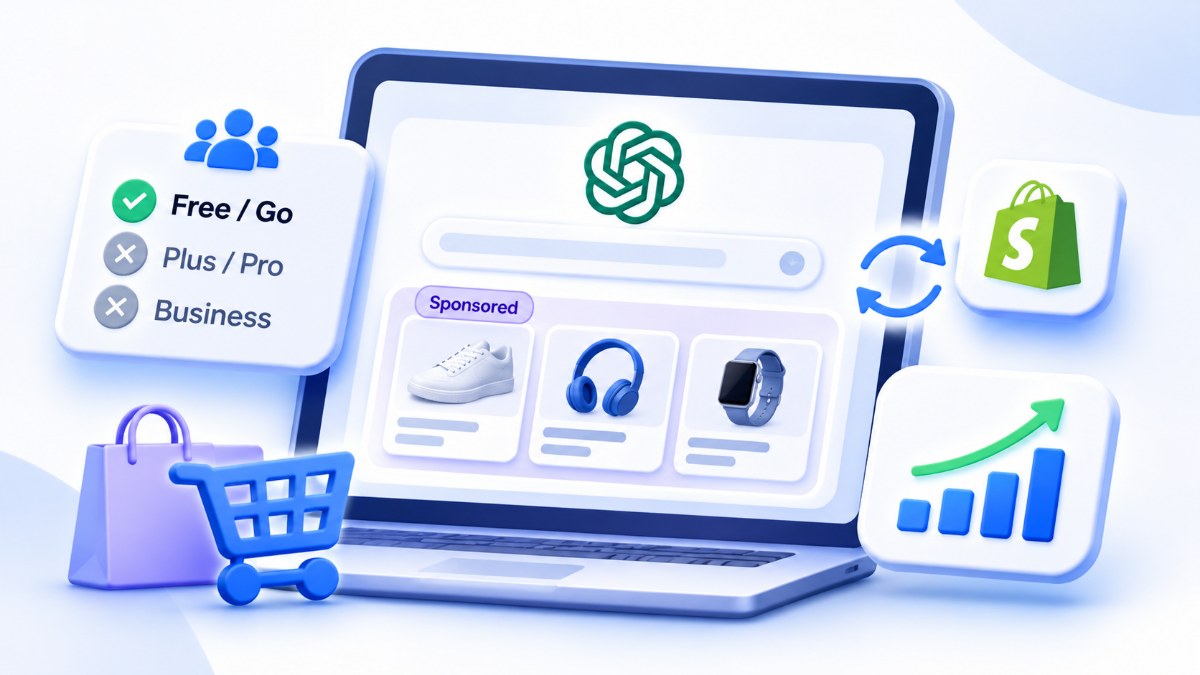
OpenAI began testing ads in the U.S. on February 9, 2026, for logged-in adults on the Free and Go plans. Plus, Pro, Business, Enterprise and Education plans do not show ads, according to OpenAI. Ads are labeled as sponsored and kept visually separate from the answer, and OpenAI states that they do not influence what ChatGPT answers. They are also not shown to accounts under 18 or near sensitive topics such as health, mental health and politics.
The takeaway: your reach is the free-tier audience, not every ChatGPT user.
2. Availability has expanded quickly
By August 11, 2026, ads had launched in the United Kingdom, Mexico, Brazil, Japan and South Korea. On August 31, 2026, OpenAI said ChatGPT Ads is available in over 40 countries and that self-serve buying had opened across India, Europe, the Middle East and North Africa. The same page states that ChatGPT has more than 1 billion weekly active users and that ads reached a $1 billion annualized revenue run rate in under 200 days. Our roundup of ChatGPT ads statistics for e-commerce brands puts these figures next to early advertiser and traffic data.
3. You can buy ads yourself
On May 5, 2026, OpenAI announced a beta self-serve Ads Manager. Advertisers add payment details, set budgets, bids and pacing, upload ads and review performance. Agencies such as Dentsu, Omnicom, Publicis and WPP also buy on behalf of clients. The first pilot phase used cost per thousand impressions (CPM); cost per click (CPC) bidding was added so you pay only when someone clicks.
4. Measurement relies on a pixel and the Conversions API
OpenAI launched pixel-based measurement and a Conversions API to track purchases, leads and sign-ups. Advertisers receive aggregated insights, never individual conversations. OpenAI also says CPC and outcome-optimized bidding now account for the majority of campaigns, so set up conversion tracking before you spend.
5. Your product feed is becoming the engine
Digiday reported that OpenAI is adding catalog-based ads: retailers connect a product catalog, set filters for eligible products, and ads are generated from each product's name, image and attributes. At the time of that report, no public launch date had been given. New e-commerce partners were asked for a sample of 100 products first.
If you sell on Shopify, OpenAI's ChatGPT Ads app for Shopify syncs your catalog and commerce events to Ads Manager; it is currently available to Shopify customers in the U.S. OpenAI's product feed spec requires nine base fields (item_id, title, description, url, brand, seller_name, image_url, availability and price) plus target_countries and store_country, and suggests titles of at most 150 characters.
That is very close to what a strong Google feed already contains. If your data is thin, start with our guide to the key points of an optimized Google Shopping feed and learn how to enrich product titles.
6. Checkout happens on your own store
On March 24, 2026, OpenAI said that merchants can use their own checkout experiences while it focuses on product discovery. OpenAI also said Shopify merchants' product data is already in ChatGPT through Shopify Catalog. In practice, the sale closes on your site, so your product pages and checkout carry the conversion.
7. Early results are mixed, so test small
Independent data is still thin. A working paper cited by Digiday found revenue per session of $0.89 for paid ChatGPT visits versus $2.45 for paid Google Search, with conversion rates of 0.37% versus 1.17%. Sensor Tower data in the same article shows shopping's share of U.S. ChatGPT ad spend falling from 38% in April 2026 to 20% in September. OpenAI, for its part, reports that one e-commerce advertiser saw a 3x return on ad spend over 28 days.
| Metric (U.S. advertisers) | Paid ChatGPT visits | Paid Google Search |
|---|---|---|
| Revenue per session | $0.89 | $2.45 |
| Conversion rate | 0.37% | 1.17% |
Read together, these numbers say the channel is real but unproven. Start with a small budget, a tight product set and clear conversion tracking. To see how AI surfaces compare with classic listings, read AI Mode vs. traditional product listings on Google and our guide to AI shopping visibility in Merchant Center.
How to prepare your store before running campaigns
Treat ChatGPT as a new advertising platform with its own setup, not a copy of your Google account. Four steps keep the test cheap and measurable.
First, decide the objective and the optimization event. The Shopify app, for example, asks for a campaign name, budget, optimization event and targeting, and lets you choose an ad group of all products, a single product or your website.
Second, understand the targeting signals. OpenAI says ads are matched to the context of the current conversation and, depending on country and user settings, to broader ChatGPT context. Targeting options include product feeds, platform and geographic targeting, and custom audiences. Users can control how personalized their ad experience is, so intent signals are softer than on search.
Third, check your creative inputs. Because catalog ads are built from your feed, the product title, image and attributes act as the ad. Include a clear brand, a plain-text description and a sharp main image, and write titles that describe the item the way a shopper would ask for it in a chat.
Fourth, plan your reporting. OpenAI shares aggregated performance data, so compare running campaigns by cost per conversion in your own analytics, not by clicks alone. A small team can review results weekly, pause what does not convert and expand only the product groups that pay back.
Keep the marketing brief short. Create one note per product group, explore which items shoppers already request in chat, and provide the information they need to decide: price, availability, shipping and returns. A feed management tool or service can submit that information in the right format, so multiple teams work from one source. Design landing pages that match the ad, and use the wording of real shopper questions as your keyword guide.
Frequently asked questions
Do ChatGPT Ads change ChatGPT's answers?
No. OpenAI states that ads do not influence the answers ChatGPT gives, and ads are labeled and shown separately from the response.
Can I advertise outside the U.S.?
Yes. OpenAI reported availability in over 40 countries on August 31, 2026, although the Shopify app was still limited to U.S. customers when OpenAI last updated its help page.
Do advertisers see what users type?
No. Advertisers get aggregate performance data such as views and clicks, not chats, chat history, memories or personal details.
Do I need a product feed to start?
Not for every format. The Shopify app also supports a website ad type, but catalog ads depend on a clean feed, so it pays to prepare one early.
Final thoughts
ChatGPT Ads and Google Shopping run on the same raw material: complete, accurate and well-written product data. Fix your titles, descriptions and attributes once, and every channel benefits. Clarmix feed enrichment helps you do that at catalog scale.
Sources
- OpenAI: Testing ads in ChatGPT
- OpenAI: A milestone in expanding access to AI
- OpenAI: New ways to buy ChatGPT ads
- OpenAI: Powering product discovery in ChatGPT
- OpenAI Help Center: Set up ChatGPT Ads for Shopify
- OpenAI developers: Product feed spec
- Digiday: OpenAI makes it easier to run shopping ads in ChatGPT
- Digiday: Six thousand brands later, ChatGPT ads still have a conversion problem
Join our monthly tips!
Get fresh insights on Google Shopping optimization delivered straight to your inbox.