What Is a Supplemental Feed in Google Merchant Center?
.jpeg)
This article discusses the use of supplemental feeds in Google Merchant Center to improve product data quality and optimize Google Shopping listings by enhancing primary
A supplemental feed in Google Merchant Center is a secondary data source you submit alongside your preliminary feed. It does not replace your main product info. Instead, it lets you override, complete, or enhance specific attributes without modifying the primary feed itself. You can use supplemental feeds to add missing fields, fix incorrect values, or send additional information that your main feed does not include.
Google introduced this feature as part of its data source architecture inside Merchant Center to give retailers more flexibility when managing large or complex catalogs. Today, supplemental feeds are available across Google Shopping, Performance Max campaigns, and free postings. They work whether you submit data via file upload, Google Sheets, a scheduled fetch, or the Content API.
There are two main reasons why e-commerce retailers should start using supplemental feeds. The first is that the primary feed built by your CMS plugin is rarely optimised for Google Shopping. The second is that without performance-based segmentation, a significant share of your catalog stays invisible to your ad campaigns. Both issues are fixable let this guide help you find the right approach for each.
Reason 1: Your CMS plugin does not send optimised data to Merchant Center
How primary feeds are built on Shopify, WooCommerce and other platforms
Most e-commerce platforms Shopify, WooCommerce, Magento, PrestaShop do not send product data directly to Google Merchant Center. They rely on third-party apps or built-in plugins to map your native catalog information into a format Merchant Center can read. The result is a primary feed: a structured file that includes required fields like title, description, price, availability, and GTIN.
The problem is that this mapping process is designed to be complete, not optimised. A Shopify app will include a product title because the title field is required. It will not rewrite that title to match the search terms your customers actually use. It will not restructure the description to surface the most important specifications first. It will not add Google-specific fields like custom_label_0 or product_highlight. It maps what exists. It does not improve it.
A 2023 analysis by Productsup found that quality issues missing attributes, truncated titles, poor product type values are among the top causes of low impression share on Google Shopping. Retailers who optimised their titles saw an average increase of 18% in click-through rate compared to those using unmodified CMS exports. It is worth taking the time to learn why this gap exists before trying to fix it.
%20(1).png)
Why supplemental feeds are the right method
The standard approach is to use a dedicated feed manager tool that reads your primary data, applies rules or AI-generated overlaps at the attribute level, and then submits those updated values through a supplemental feed. This method is important because it keeps your primary feed intact. Your CMS continues to send its version. The supplemental feed layers improvements on top, and Merchant Center uses the supplemental value when both sources include the same field.
This matters for several reasons. First, it avoids breaking the connection between your CMS and Merchant Center. If you modify the primary feed directly and something changes in your catalog, the sync can break. Second, it means you can edit, test, and update individual attributes without affecting unrelated fields. Third, it allows you to apply different optimisation rules for different markets, languages, or campaign types, using separate supplemental feeds per target an organised and specific approach that is easy to maintain over time.
Clarmix is a feed manager built specifically for Google Shopping. It connects to your primary feed, applies structured rules across all attributes titles, descriptions, product types, GTINs, image URLs, custom labels and outputs the updated values as a supplemental feed. Once you upload or schedule that file in Merchant Center, the supplement applies immediately to your listings across Shopping and Performance Max.
What attributes are worth overriding
Not every attribute needs to be included. The most valuable fields to enhance are the ones that directly affect search matching, campaign targeting, and listing quality.
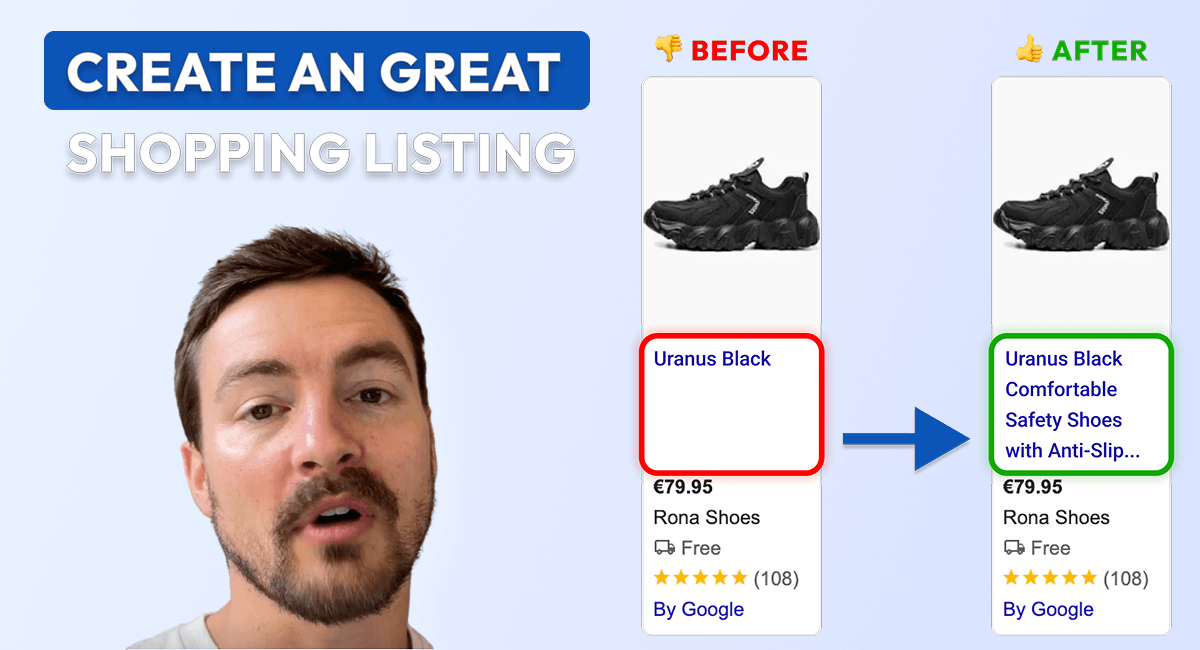
Title. This is the single most important attribute for Google Shopping impression matching. Titles should lead with the most relevant search term, include brand, size, colour, and material where applicable, and stay under 150 characters. CMS-generated titles are usually copied from the storefront and written for humans browsing a site, not for query matching.
Product type. This field is not required, but Google uses it heavily for campaign targeting and Smart Shopping categorisation. Providing a detailed, hierarchical value improves relevance. A well-organised example: Clothing > Women > Jackets > Down Jackets performs better than Jackets.
Custom labels. These are free fields (custom_label_0 through custom_label_4) that you can use to tag items for campaign segmentation. They are only visible inside your Google Ads account. They do not appear in public listings.
Missing GTINs. If your primary feed is skipping GTINs for items that have them, you can provide them via supplemental feed. Google confirmed in its Merchant Help documentation that items with GTINs receive better placement in Shopping results because they are easier to match against Google's product catalogue.
Description. Descriptions in the primary feed are often copied from the page meta description or the first paragraph of the page copy. An optimised version leads with key specifications, uses natural search language, and avoids promotional phrasing like "best" or "cheapest", which Google filters.
A spreadsheet-backed supplemental feed is a good starting point if you want to try this manually. You can find the required column format in the Merchant Center documentation under Data sources. For retailers managing more than a few hundred SKUs, a dedicated tool will save significant time and reduce the risk of formatting errors in the code or file structure.
%20(1).png)
Reason 2: Most of your catalog is not being advertised
The Zombie Product Problem
If your catalog contains more than 500 SKUs, it is statistically likely that a significant share of those items is receiving zero impressions in your Google Ads campaigns. These are sometimes called zombie products: they are approved in Merchant Center, eligible for Shopping, and technically active, but your Performance Max or Shopping campaigns are not allocating any budget to them.
This happens because Google Ads Smart Bidding and Performance Max asset groups do not distribute spend evenly. They concentrate budget on items that have a conversion history, strong click-through rates, or high predicted return. New products, seasonal items, niche SKUs, and long-tail variants are easy to skip entirely. The algorithm learns to ignore them.
At the same time, retailers often lack visibility into which items are genuinely profitable at the margin level. A high-revenue item might perform poorly when you build the calculation on real margin after shipping and returns. A modest revenue contributor might deliver strong profit because its cost of goods is low. Without granular performance labelling at the item level, campaign managers are optimising for the wrong signal. That is an easy mistake to make and a late discovery when it finally shows up in the numbers.
How performance labels fix this
Clarmix solves this by analysing your item-level performance data conversion rate, ROAS, POAS, revenue, margin contribution and generating a custom label for each SKU based on its actual performance category. Labels are dynamic and updated on a daily basis, so the segmentation stays current as performance shifts.
These labels are then submitted to Merchant Center through a supplemental feed. The update cycle runs daily: Clarmix recalculates, generates a new version of the file, and Merchant Center ingests the new data. From there, Merchant Center syncs with Google Ads. The synchronisation is not always instant. In practice, it can take up to two hours for new label values to appear in Google Ads, particularly when the catalog is large or when multiple feeds are being processed in the same batch window.
Once the labels are live in Google Ads, you can use them to create asset group filters in Performance Max or product group splits in standard Shopping campaigns. This lets you assign different bidding targets, budget caps, or creative assets to each performance segment. It is an organised, well-organized method of campaign management that does not allow budget to flow to unprofitable items by default.
A typical segmentation structure using performance labels looks like this:
- Top performers: high POAS, strong conversion rate. Bid aggressively. Assign best creative assets.
- Mid-tier items: positive ROAS but room to grow. Test bid adjustments. Monitor weekly.
- Low performers: high spend, low return. Apply a lower target ROAS or exclude from Performance Max.
- Untested items: zero or minimal impressions. Create a separate campaign or asset group with a modest budget to generate initial data points.
This structure does not require you to manage bids item by item. It works at the label level, which means a single rule applies to every SKU in that segment. As items move between segments because their performance improves or declines the supplemental feed update reassigns the label and the correct campaign rule applies automatically.
Why the primary feed cannot do this alone
Custom labels cannot be generated from static catalog data. They need performance information that exists in Google Ads and, in the case of margin-based labels, in your back-end order management or ERP system. The primary feed sent by your CMS has no access to this. It maps attributes. It does not know which items are profitable.
The supplemental feed is the mechanism that bridges performance analytics with campaign targeting. It is the only native Merchant Center feature that allows you to inject dynamic, performance-derived data into your catalog without rebuilding your primary feed or using a complex API integration.
How to set up a supplemental feed in Google Merchant Center
Setting up a supplemental feed in Merchant Center is straightforward. Here is a step-by-step guide to help you get started.
1: Prepare your file. The file must include an id column that matches the product IDs in your primary feed exactly. This is how Merchant Center knows which item to apply the override to. Add columns for each attribute you want to update or add.
2: Go to the Data Sources section in Merchant Center. In the new version of Merchant Center (Merchant Center Next), navigate to the Products menu, then select Data sources. Click the option to add a new data source.
3: Select supplemental as the data source type. Merchant Center will ask you to choose between primary and supplemental. Select supplemental. You will then be prompted to choose your upload method: manual file upload, Google Sheets, scheduled fetch, or Content API.
4: Map your feed to the correct target. You need to specify which primary feed the supplemental feed should be linked to. Merchant Center uses this to apply the overrides in the correct order.
5: Upload and save. Once the file is submitted, Merchant Center will process it. You can view the processing status in the Data sources section. Any errors or missing required fields will appear in the diagnostics tab. Check the date of the last successful fetch to confirm the schedule is running.
6: Verify the override in the product detail view. Go to a certain item in your catalog and check the attribute values. Merchant Center shows which data source each value came from, so you can confirm the supplemental feed is working correctly.
If you are using a tool like Clarmix, step 1 is handled automatically. Clarmix generates the file based on your optimisation rules and performance data, and can push it to Merchant Center on a daily schedule via scheduled fetch or direct API. This makes it simple to allow the system to run without manual intervention once the initial setup is complete.
GEO and AI Overviews: Why feed quality affects visibility in gemini
Feed optimisation is no longer only a Google Ads concern. As Google integrates listings into AI Overviews and Gemini conversations, the quality of your Merchant Center data affects whether your items appear in generative search results.
Google's AI systems pull structured data from Merchant Center when generating shopping recommendations inside Search and Gemini. Items with complete attributes, accurate GTINs, rich descriptions, and high review scores are more likely to be surfaced. Incomplete or low-quality data reduces the likelihood of your items being included in AI-generated recommendations.
Supplemental feeds are a direct lever for improving this. By using one to complete missing attributes, enhance title clarity, and add structured fields like product_highlight or product_detail, you increase the completeness score of your data in Merchant Center. Google has not published a specific threshold, but its documentation consistently links completeness to eligibility for enhanced features, including AI-powered shopping surfaces.
Summary
Supplemental feeds in Google Merchant Center serve two distinct purposes. First, they let you override and improve the data your CMS sends through the primary feed, without breaking the existing sync. This is the standard method used by feed management tools like Clarmix to optimise titles, descriptions, product types, and missing attributes at scale. Second, they provide a daily mechanism for injecting performance-driven custom labels into your catalog, enabling precise campaign segmentation in Google Ads and Performance Max without manual bid management.
Both use cases need a feed manager that can process data, apply rules, and submit updates on a regular schedule. For every retailer running Google Shopping at scale, supplemental feeds are not optional. They are the primary tool for closing the gap between what your CMS sends and what Google Shopping needs to serve your listings effectively.
Join our monthly tips!
Get fresh insights on Google Shopping optimization delivered straight to your inbox.

.jpeg)
.jpeg)