ACP, UCP, and MCP: Differences for E-Commerce Stores
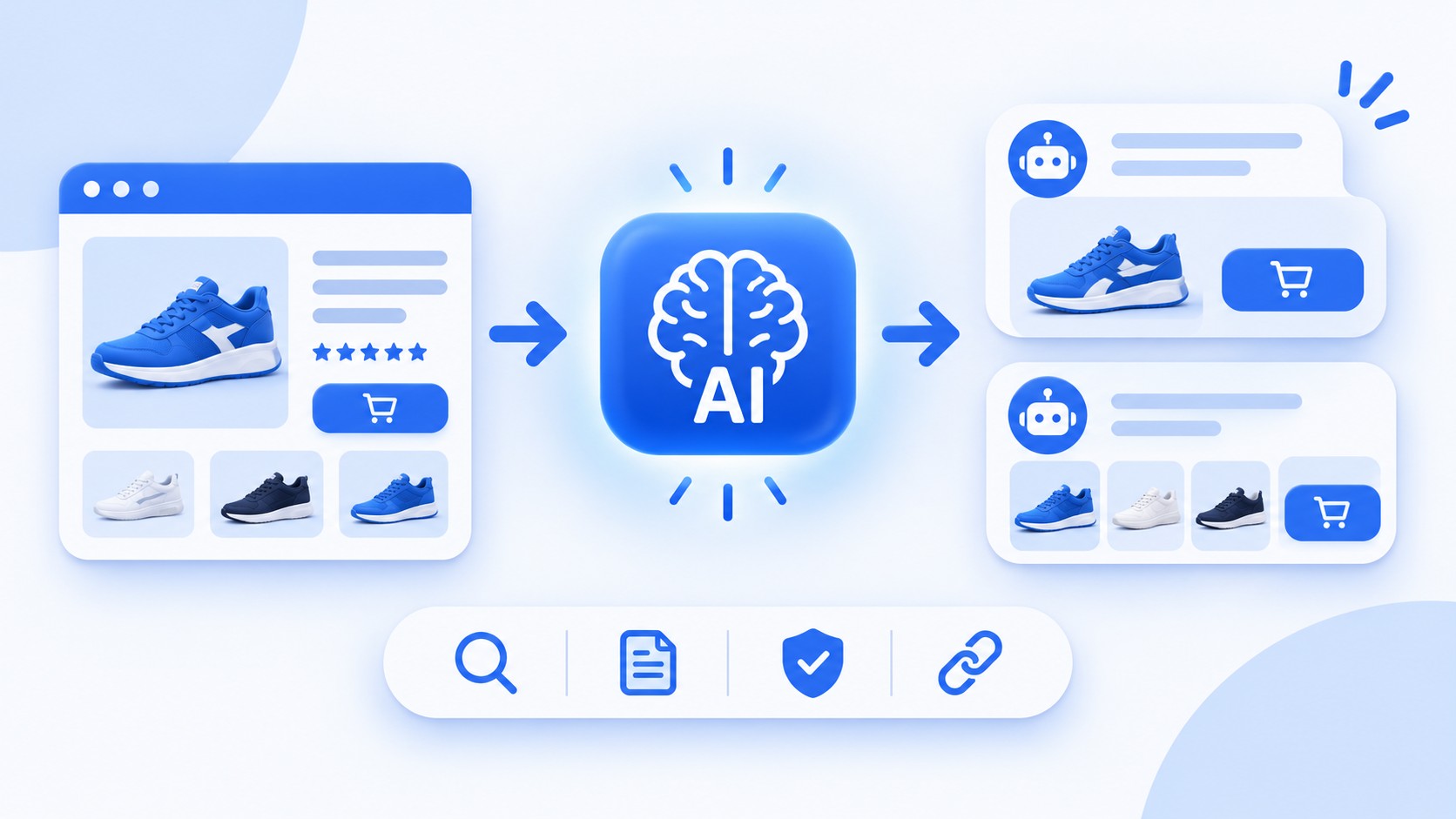
ACP, UCP, and MCP explained for e-commerce stores: what each protocol does, how they differ, and what merchants should do now.
AI agents are starting to do more than recommend products. They can check stock, compare offers, and in some cases complete the purchase. Three acronyms keep coming up when people explain how: ACP, UCP, and MCP. They sound interchangeable, but they solve different problems, and only some of them require anything from your store.
The short version: MCP (Model Context Protocol) connects AI applications to tools and data. UCP (Universal Commerce Protocol) is Google's open standard for agentic commerce, covering product discovery and checkout. ACP (Agentic Commerce Protocol) is the standard OpenAI and Stripe built for checkout inside ChatGPT. This guide explains how they overlap and what a small merchant should do about them.
ACP vs. UCP vs. MCP at a glance
| Protocol | Created by | What it does | Where a merchant meets it |
|---|---|---|---|
| MCP (Model Context Protocol) | Open-source community standard | Connects AI apps to external tools and data | Tools that let an assistant read your account data |
| UCP (Universal Commerce Protocol) | Google, with retail and payment partners | Lets agents discover products and complete checkout with a merchant | Google surfaces, set up through Merchant Center |
| ACP (Agentic Commerce Protocol) | OpenAI and Stripe | Lets an agent pass an order and payment to a merchant | Instant Checkout in ChatGPT |
MCP: the connector, not a commerce standard
The Model Context Protocol is an open-source standard for connecting AI applications to external systems, and its documentation compares it to a USB-C port for AI. It has nothing to do with shopping on its own. It simply lets an assistant like Claude or ChatGPT call a tool, run a query, or fetch a file from a calendar, a database, or an advertising account.
For e-commerce, that means MCP is how an assistant reads and works with your data. Google now offers an Merchant API MCP service in alpha that gives an assistant access to Merchant Center data, such as product disapprovals and performance reports. MCP is the plumbing.
UCP: Google's open standard for agentic commerce
Google described the Universal Commerce Protocol in a January 2026 developer post as an open-source standard developed with partners including Shopify, Etsy, Wayfair, Target, and Walmart, and endorsed by payment companies such as Adyen, American Express, Mastercard, Stripe, and Visa. UCP uses a single, standard profile published on the business domain, so an agent does not need a custom interface for every store. A business declares each capability it supports, and agents use that list to know what they can ask for. The core capabilities include checkout, discounts, and fulfillment.
Google has kept extending it. In March 2026 it added Cart, Catalog, and Identity Linking as optional capabilities, and at Google Marketing Live in May it introduced Universal Cart with Google Pay checkout. UCP is designed to work with other standards: Google's support page says it is compatible with A2A, AP2, and MCP.
Here is how UCP works with Merchant Center. The product data you already send stays the foundation, and only products with the native_commerce checkout eligibility attribute can show a Buy button. Merchants who want to use UCP start with an interest form, then build the technical integration: Google's overview says native checkout needs three REST endpoints for creating, updating, and completing a session. You remain the seller of record, and shoppers pay with Google Pay.
Availability is limited. Google's developer overview says UCP checkout is gradually rolling out in the United States, with Australia and Canada to follow, so check the current status for your market before planning around it.
ACP: OpenAI and Stripe's checkout standard
The Agentic Commerce Protocol was released on September 29, 2025, alongside Instant Checkout in ChatGPT. When a shopper buys, Stripe issues a Shared Payment Token scoped to a specific merchant and cart total, and the order flows to the merchant's backend. The merchant still accepts or declines the order, charges the payment method, and handles fulfillment and returns.
ACP is open source under the Apache 2.0 license and is still labeled beta, with OpenAI and Stripe as founding maintainers. You do not have to use Stripe: the announcement says businesses that do not process with Stripe can adopt it with their existing payment providers. Getting into ChatGPT is a separate step. The ACP site says each AI platform manages its own process, and for ChatGPT you need to apply.
What happens when an agent buys something
Walk through one purchase to see where each protocol earns its keep. A shopper asks an AI assistant, such as ChatGPT or Gemini, for waterproof hiking boots under $150. Discovery comes first. The agent searches, reads the shopper's intent, and compares attributes, pricing, and real-time inventory from product data. That is why a clean catalog matters: an agent cannot recommend what it cannot parse.
Once the shopper picks a pair, the agent needs the retailer to confirm details. With UCP, it reads the business profile, sees which capabilities the store offers, and opens a checkout session where a discount or shipping option can be applied. The transaction can then complete without the shopper visiting your site first, which aims to cut the friction of traditional click-through shopping. With ACP the sequence is similar, but the order and payment token travel through the OpenAI and Stripe flow. Behind both, MCP may be how an agent reaches the inventory system or customer record that answers each question.
For a brand or retailer, the takeaway is practical. Standards like these allow AI agents to discover and buy from stores they have never seen before, so the quality of your data becomes part of the experience, not just a ranking factor.
How the three fit together
At a high level, think of it in layers. MCP sits underneath as a way to reach tools and data. UCP and ACP sit on top as commerce standards, each tied to a different set of AI surfaces. Neither replaces the other, and both can talk to MCP. UCP offers an MCP binding for checkout, and ACP's latest spec lists MCP support alongside cart, feed, and orders.
That layered design is what lets the ecosystem grow without every store building a separate integration. So the real question is not which protocol wins. It is which AI surfaces your customers use and which of them have opened the door to merchants of your size.
What small merchants should do now
Most stores do not need to write protocol code today. Platforms and payment providers usually handle the integration, so your first job is to find out what yours supports. Beyond that, the work is mostly the same as it has always been:
Get your product data right. Agents can only recommend or sell what they understand. Ensure titles, attributes, and prices match your site. They matter more as AI answers replace lists of links, as we explain in our guide to AI shopping visibility in Merchant Center.
Keep Merchant Center healthy. UCP builds on it, so a clean Merchant Center account is the starting point.
Watch availability. Both programs are rolling out in stages, so register interest where you can and revisit the status every few months.
Frequently asked questions
Do I have to choose between ACP and UCP?
No. They serve different AI surfaces, and a merchant can eventually support both. The decision usually follows your platform or payment provider.
Is MCP a replacement for either one?
No. MCP connects an assistant to tools and data. UCP and ACP define how a purchase is carried out.
Final thoughts
ACP, UCP, and MCP will keep evolving, but they all depend on the same thing: clear, accurate product information. The industry is still moving, but the shift toward agent-led shopping is already here, and in this new era of the digital shelf, machines read your catalog first. Start with your data. Clarmix Feed Enrichment improves titles and attributes in your Google Shopping feed at scale.
Sources
Join our monthly tips!
Get fresh insights on Google Shopping optimization delivered straight to your inbox.